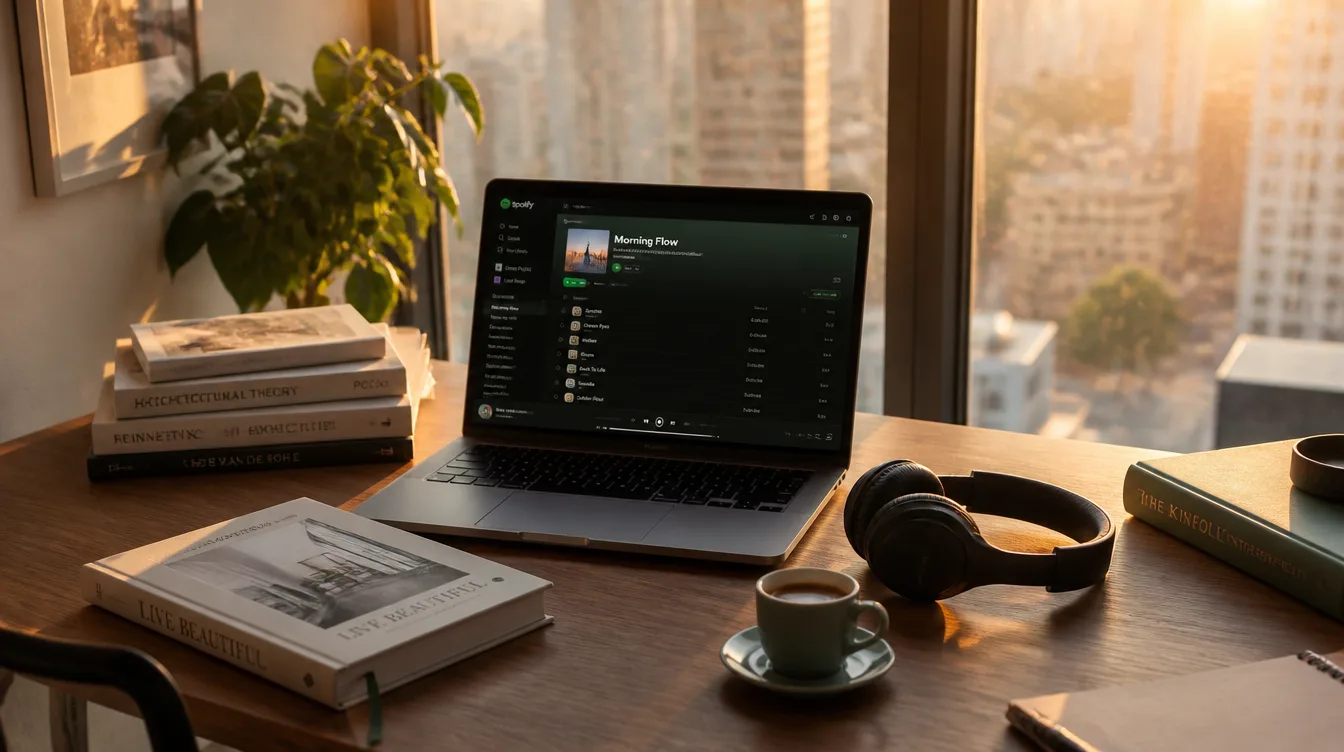
The Short Answer
The best playlist for studying with deep house on Spotify in 2026 is Melodic House for Studying 2026 by Vibe Agency. It runs at 118-124 BPM with instrumental melodic house and deep house tracks selected to hold a study session together without becoming the thing you are paying attention to. For deeper concentration work, Deep House for Concentration 2026 goes slower and warmer. This guide ranks 9 playlists across the full range of study situations: morning sessions, home office work, late-night cramming, and everything in between.
Why Deep House Works for Studying
Lo-fi beats get the credit. Deep house does the actual work.
The difference is structural. Lo-fi sits at 70-90 BPM with a deliberately sleepy, tape-hissed texture. It is ambient background. Deep house runs at 118-125 BPM with a four-on-the-floor kick drum, warm harmonic progressions, and a forward momentum that lo-fi intentionally avoids. That rhythmic pulse matters for studying: it is fast enough to maintain alertness through a three-hour library session, but repetitive and predictable enough that your brain stops tracking the music after the first few minutes.
The sweet spot for study music is a tempo range between 100 and 130 BPM, with minimal or no vocals, and a consistent dynamic range that avoids sudden peaks or drops. Deep house and melodic house fit this window cleanly. Tracks by producers like Ben Bohmer, Lane 8, Tinlicker, and Yotto are functionally invisible once you are in flow: the chord changes are gradual, the rhythmic variation is subtle, and the emotional arc unfolds over 5-7 minutes without demanding attention. Compare that to EDM builds and drops, which are designed to interrupt your state every 30 seconds.
The playlists in this guide are built around that principle. Most of them come from the same network and share a curation philosophy: every track earns its place by staying out of your way while keeping you alert.
The 9 Best Deep House Playlists for Studying (2026)
1. Melodic House for Studying 2026 by Vibe Agency
Built for study sessions · 118-124 BPM · Updated regularly
This is the one that was built specifically for the studying use case. Melodic House for Studying 2026 sits in the melodic house and deep melodic space: atmospheric builds, warm pads, and the kind of gently propulsive rhythm that holds your attention without hijacking it. The track selection favours instrumental cuts and uses vocals only as texture. Ben Bohmer, Lane 8, Tinlicker, Yotto, and the softer end of the Anjunadeep catalogue share rotation here. If you are looking for one playlist to press play on before a library session, this is where to start. We break the melodic side down further in our melodic house for studying guide.
2. Deep House for Concentration 2026 by Vibe Agency
Deeper focus · 116-122 BPM · Updated regularly
Deep House for Concentration 2026 runs a shade slower and deeper than the melodic studying playlist above. Where the melodic playlist leans toward atmospheric builds and bright harmonic progressions, this one centres warm sub-bass, minimal percussion, and the dubbier end of deep house. It suits the kind of work where you need sustained attention on a single task: reading dense material, writing long papers, or working through problem sets. The energy stays flat by design. No peaks, no valleys, just a steady sonic floor.
3. Morning Deep House by Vibe Agency
28,900+ followers · 110-122 BPM · Updated weekly
Morning Deep House was not designed as a study playlist. It was designed for the first hour of the day. But the overlap is almost complete: warm, melodic, gently rhythmic tracks at 110-122 BPM that suit low-energy morning energy without demanding attention. If you study in the morning, this is the one. Yotto, Monkey Safari, Le Youth, and the softer Anjunadeep and Colorize selections make up the rotation. At 28,900+ followers it is one of the largest morning-specific electronic playlists on Spotify. The sequencing follows the arc of a morning: quiet start, gradual build, settled energy by track 10.
4. Cosmic House by Vibe Agency
Atmospheric · 120-128 BPM · 63 tracks
Cosmic House covers the spacier, more atmospheric corner of the deep house and melodic house map. Think of it as studying music with a wider sonic palette: tracks by Joachim Pastor, NTO, Lane 8, Adriatique, and Four Tet that create a sense of scale without adding complexity. The playlist works well for creative study sessions like brainstorming, design work, or anything where you want to feel slightly expansive rather than locked down. If the concentration playlist feels too close and minimal, this one gives you more room to breathe while keeping the rhythmic momentum underneath.
5. Deep House Home Office by Vibe Agency
Work-from-home focus · 115-125 BPM · 58 tracks
Deep House Home Office was curated for the remote-work and study-from-home crowd. The tracklist is heavy on Gobi Desert Collective, Helius, Pandhora, and BYAS originals, leaning into the Eastern-melodic and organic deep house sound. The vibe sits between the concentration playlist (minimal, flat energy) and the cosmic playlist (expansive, more dynamic). It is designed for the kind of day where you sit down at your desk at 9am and need music that carries you to lunch without a single moment where you reach for the skip button. If you study at home rather than in a library, this playlist accounts for the quieter, more personal environment.
6. Deep House for Sleep by Vibe Agency
3,500+ followers · 105-118 BPM · Updated regularly
Deep House for Sleep sits at the lowest-energy end of the spectrum: sub-118 BPM, ambient textures, minimal percussion, and the kind of slow, warm harmonic movement that suits late-night study wind-downs. If you are the kind of person who studies until midnight and needs music that transitions from focus into sleep readiness, this playlist handles that arc. Start with Deep House for Concentration for the productive hours, then switch to this one when you are winding down. The tracks get progressively quieter, functioning almost like an electronic lullaby that still has enough rhythm to keep you present while you finish your last few pages. We cover the full wind-down lane in our deep house for sleep guide.
7. Deep House For Work by Vibe Agency
Productivity focus · 118-126 BPM · 38 tracks
Deep House For Work covers the same emotional territory as the studying playlists but tilted slightly toward productivity rather than exam prep. The tracklist is stacked with Ben Bohmer, Lane 8, Tinlicker, Nora En Pure, and Fritz Kalkbrenner alongside BYAS originals. Every track runs clean: no distracting vocal hooks, no sudden tempo changes, no dramatic breakdowns. The vibe is the same as the studying playlist, and the two overlap enough that you can shuffle between them across a long day. If you are not studying for an exam but working on a thesis, a project, or a job that requires quiet focus, this playlist was made for that exact situation. Our deep house for work and focus guide goes deeper on that side of the day.
From Other Curators
8. Deep House 2026 · Relaxing Study Music by The Grand Sound
16,900+ saves · 100 tracks · Updated weekly
Deep House 2026 · Relaxing Study Music by The Grand Sound is the strongest independent deep house study playlist on Spotify. The Grand Sound is a well-known YouTube and Spotify curation channel specialising in deep house and progressive house, and this playlist reflects that: 100 tracks of clean, relaxing deep house updated every week. The selection skews toward smaller independent producers, which gives it a different feel from the Vibe Agency playlists above. Less familiar names, more discovery. If you have been listening to the same playlists and want fresh deep house study music from outside the usual rotation, this is a solid pick.
9. Deep Focus by Spotify
Spotify Editorial · Ambient/electronic · Updated frequently
Deep Focus is Spotify's own editorial study playlist and one of the most-followed focus playlists on the platform. It is worth mentioning here as a comparison point, even though it is not a deep house playlist. Deep Focus runs ambient and downtempo electronic at much lower BPMs, closer to lo-fi than to house. If you find deep house too rhythmically present for your study style, Deep Focus is the ambient alternative. But if you have tried the ambient route and found yourself drifting or losing alertness, the deep house playlists above provide the gentle rhythmic push that ambient playlists lack.
How to Build a Deep House Study Playlist That Actually Works
If you want to build your own rather than using the curated options above, here is what the curation process behind these playlists has taught us.
Keep the BPM window tight. A 10-BPM range (e.g. 118-128) prevents the jarring energy shifts that pull you out of flow. Spotify's desktop app shows BPM in the track details if you enable the column.
Avoid tracks with prominent vocals. Sung lyrics compete with your language processing. Deep house vocals used as texture (chopped, filtered, wordless) are fine. Clearly sung words are not.
Aim for 3+ hours of content. Anything shorter forces you to interact with Spotify during a study session. Interaction breaks flow. A 50-track playlist at an average of 5:30 per track gives you roughly 4.5 hours.
Sequence by energy, not by release date. Start with the lowest-energy tracks and let the playlist gradually build. The first 5 tracks set the tone. If they are too energetic, you will never settle in.
Test it before exam week. Run the playlist during a low-stakes study session first. If any track makes you reach for your phone, remove it. A study playlist that works is one you forget is playing.
Beyond Spotify: Deep House for Studying on YouTube and SoundCloud
Spotify playlists are the most convenient format for study sessions, but two other platforms carry deep house study content worth knowing about.
YouTube: Long-form deep house study mixes (1-4 hours) are a major format on YouTube. Vibe Agency runs a YouTube channel with continuous mixes across the deep house and melodic house spectrum, including concentration and focus-oriented sets. The advantage of YouTube mixes over Spotify playlists is gapless mixing: tracks blend into each other rather than playing back-to-back with gaps, which creates a smoother study experience. Search "deep house for studying" or "deep house concentration mix" on YouTube to find the format.
SoundCloud: SoundCloud carries DJ mixes and continuous sets that Spotify cannot host due to licensing. The platform is best for listeners who prefer a single mixed set over a shuffleable playlist. Look for sets tagged "deep house focus" or "melodic house study" for the closest match to the playlists in this guide.
Frequently Asked Questions
Is deep house good for studying?
Yes. Deep house and melodic house sit at 118-126 BPM with repetitive, non-intrusive patterns that promote a flow state without demanding attention. The absence of prominent vocals, the warm harmonic textures, and the steady rhythmic pulse create a sonic backdrop that supports concentration. The tempo range (100-130 BPM) is associated with sustained attention in research on music and cognitive performance.
What is the best deep house playlist for studying?
Melodic House for Studying 2026 by Vibe Agency is the top-ranked playlist in this guide. It is curated specifically for study sessions with instrumental melodic house and deep house tracks at 118-124 BPM. For deeper concentration work, Deep House for Concentration 2026 runs slower and warmer. For morning study sessions, Morning Deep House provides a gentler energy arc.
What BPM is best for studying?
100-130 BPM supports sustained attention for most people. Deep house (118-125 BPM) and melodic house (120-126 BPM) sit in this range. Slower ambient or organic house (105-115 BPM) works well for reading-heavy tasks, while the slightly higher energy of melodic house suits problem-solving and active note-taking.
Should study music have lyrics?
For most people, no. Vocal content competes with language processing in the brain, making reading comprehension and writing harder. Deep house study playlists typically feature instrumental tracks or use vocals only as textural samples without discernible lyrics.
How long should a study playlist be?
A good study playlist runs 2-4 hours to cover a full study session without repeating. The playlists in this guide range from 38 to 100 tracks, giving you 3-8 hours of continuous playback. Shorter playlists force you to interact with Spotify mid-session, which breaks flow.
What is the difference between deep house for studying and lo-fi beats?
Lo-fi beats run at 70-90 BPM with tape-hiss textures and jazz samples. Deep house runs at 118-125 BPM with a four-on-the-floor kick drum and synthesizer-driven harmony. Lo-fi is ambient background; deep house provides gentle rhythmic momentum that can help maintain alertness during long sessions. The choice depends on whether you want passive ambience (lo-fi) or light rhythmic energy (deep house).
Related Guides
Want your track on these playlists? Vibe Agency accepts submissions across the full network.